
New Publication: Evaluating the 2020 European Seismic Hazard Model (ESHM20) using ShakeMap-derived ground motion fields in Greece
New Publication: Evaluating the 2020 European Seismic Hazard Model (ESHM20) using ShakeMap-derived ground motion fields in Greece
Understanding seismic hazard in Greece
We are pleased to share a new scientific publication developed within the COREu project, led by researchers from the Aristotle University of Thessaloniki (AUTH).
Reliable seismic hazard models are essential for assessing earthquake risk and ensuring the safety of critical infrastructure. The European Seismic Hazard Model 2020 (ESHM20) represents the most up-to-date, harmonised assessment of earthquake hazard across the Euro-Mediterranean region, integrating geological, seismological, and modelling data.
In this new study, Nikos Anterriotis-Kalpakidis and Anastasia Kiratzi evaluate how well ESHM20 reflects real-world earthquake shaking in Greece. To do this, they compare model predictions with observational data derived from ShakeMaps, which reconstruct the spatial distribution of ground motion during past earthquakes.
The analysis is based on decades of seismic activity in Greece, using ShakeMap-derived intensity measures such as peak ground acceleration and spectral acceleration to assess how observed shaking compares to modelled expectations.
Key findings
The study provides important insights into the performance of ESHM20 in a seismically active region:
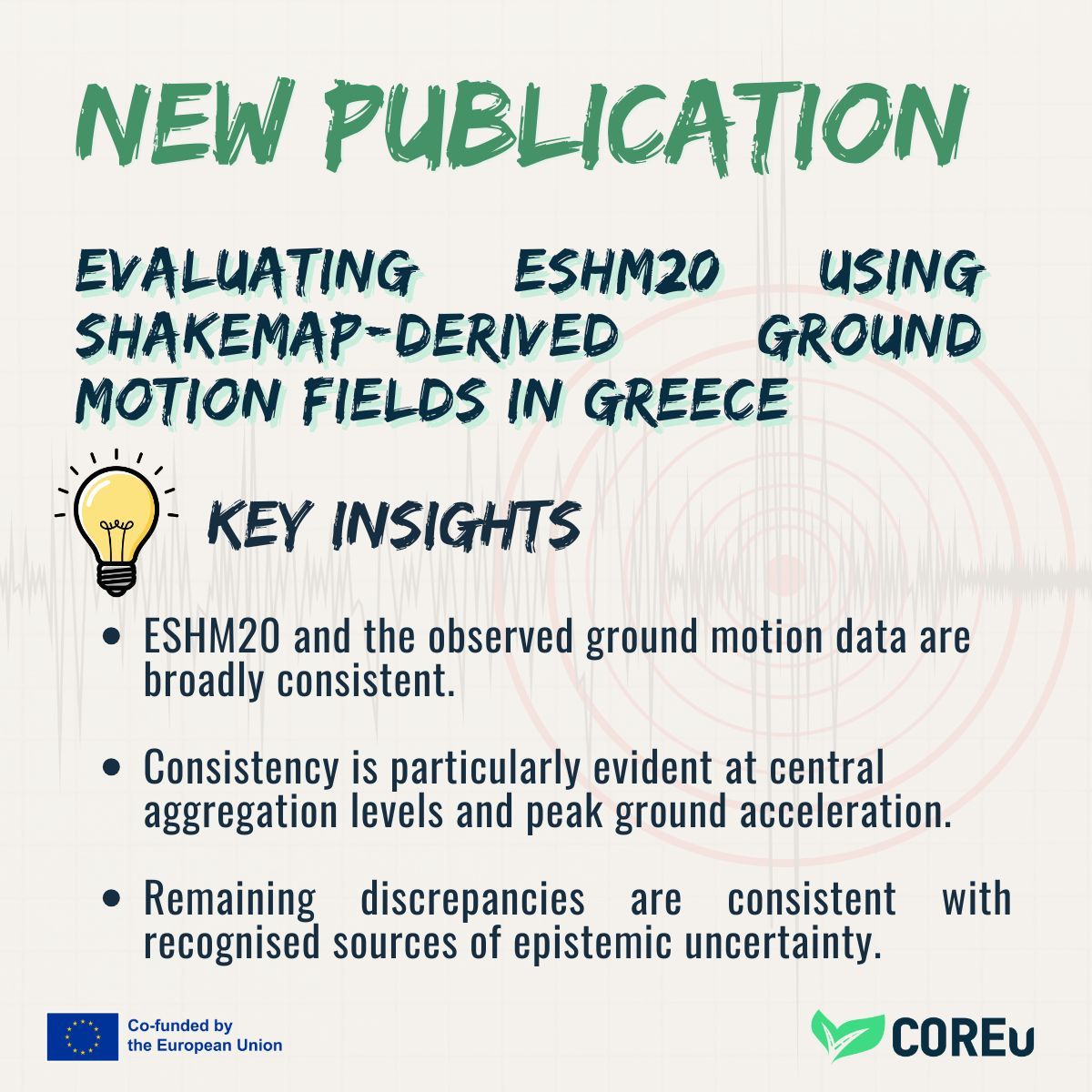
🔍 Overall consistency: ESHM20 and the observed ground motion data are broadly consistent.
🔍 Strong alignment for key indicators: The agreement is particularly clear for central aggregation levels and for peak ground acceleration.
🔍 Explained discrepancies: Remaining differences between observations and model predictions are consistent with recognised sources of epistemic uncertainty, including variability in ground motion models, site-response representation, and spatial correlation of shaking.
Why this matters for COREu
The results strengthen the scientific basis for seismic hazard assessment and monitoring, which are crucial for the safe deployment of CO₂ storage solutions within COREu, particularly for the monitoring of potential injection-related seismicity. The study contributes to a better scientific understanding of seismic risks associated with CO₂ storage, and provides insights that can support future risk assessment and decision making.
Read more
🔗 Read the full article on here.